
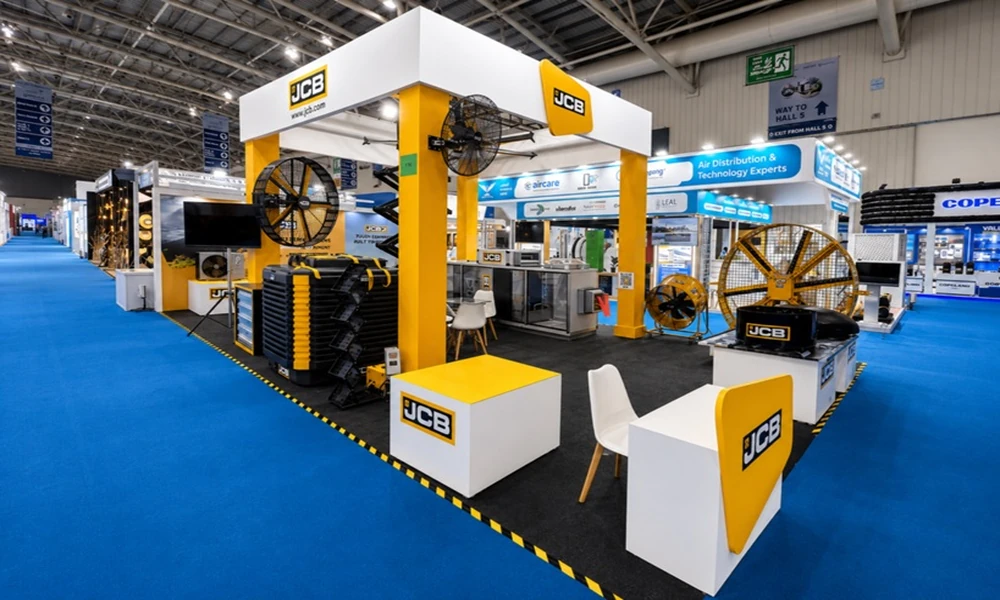
Booth design for exhibition events determines how many people stop, how long they stay, and what impression they leave with. An exhibition floor is a competitive environment. Every exhibitor within eyeline is a competing claim on visitor attention, and most visitors make their decision about whether to approach a booth within a few seconds of seeing it from a distance. A well-designed booth earns those seconds. A poorly designed booth spends the full duration of the exhibition attracting only the visitors who already know the brand.
The Three-Second Test
Visitors walking an exhibition floor are making constant decisions about where to spend their time. The booth that passes the three-second test, that communicates a clear, compelling reason to approach from across the aisle, earns foot traffic. The booth that fails it can be staffed by the best salespeople in the company and still underperform.
What passes the test? Clear visual hierarchy that puts the most important message, what the brand does or offers, at the eye-level viewing distance of an exhibition floor. A material and colour palette that stands out against the hall’s visual noise. Sufficient negative space that the booth does not read as cluttered from a distance. These are design decisions, not production decisions.
Booth design for exhibition work that passes the three-second test is built around a clear brief: what does the exhibitor want visitors to understand, feel, or do after engaging with this booth? Every design decision follows from the answer.
Zones and Flow
A well-designed exhibition booth divides its footprint into functional zones that work together. The attract zone is the outer perimeter, visible to the exhibition floor, designed for impact from a distance. The engage zone is where initial contact happens, with product displays, demo areas, or conversation spaces that give staff and visitors a reason to interact. The close zone is where more substantive conversations happen, often at the back or sides of the booth, away from the foot traffic and noise of the aisle.
Not every booth needs all three zones explicitly designed, but understanding the progression, attract, engage, close, should inform how the space is organised even in a small 3×3 metre stand.
As Goh Chok Tong has observed about Singapore’s success in building business relationships: “The first impression is the one that opens the door.” At exhibitions, the booth design is that first impression, and it is made before a single word is spoken.
Materials and Build Quality
Exhibition booth design and construction quality affects more than aesthetics. Poorly built structures that flex under their own weight, graphics applied on misaligned surfaces, or lighting that creates uneven illumination across display areas communicate something about the brand before any conversation begins. The build quality of the booth is a proxy for the quality of the company it represents.
Conversely, a booth built with well-engineered modular systems, tight graphic production quality, and thoughtful lighting positions that brand as one that attends to detail. This matters most in industries where precision and quality are central to the brand promise – technology, healthcare, financial services, and professional services.
Reuse and Modular Design
Exhibition participation across multiple events in a year justifies investment in a booth system designed for reuse. Modular systems can be reconfigured for different footprint sizes, updated with new graphics for different events, and supplemented with event-specific additions without replacing the core structure.
A booth designed for reuse requires slightly more investment at the initial build stage, but the cost per event drops substantially over subsequent exhibitions. For Singapore companies that participate in regional trade shows across ASEAN, a modular system that travels and reassembles reliably is a practical and commercial decision.
Dezign Format designs and builds exhibition booths for Singapore and regional exhibitions, from compact inline stands to large-format island exhibits. Their exhibition booth services cover concept design, production, installation, and on-site management, delivering booth design for exhibition environments where stopping power and brand clarity are the objectives.