
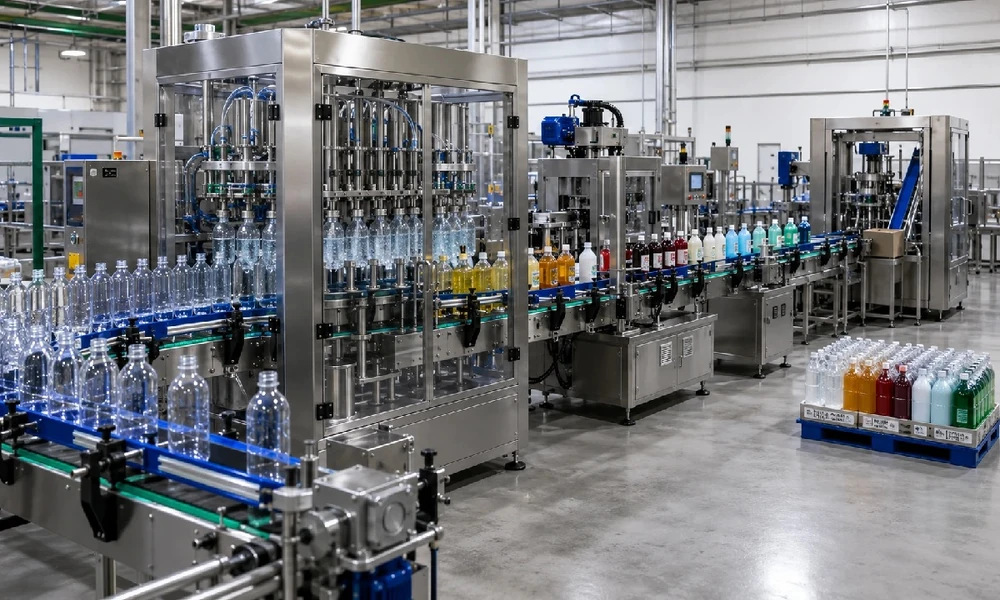
Water, shampoo, engine oil, tomato paste and molten wax are all liquids, and that is about all they share. Anyone shopping for a liquid filling machine soon finds that the word ‘liquid’ hides most of what matters. A useful way to cut through catalogues is to picture five different products arriving at the same filling hall on the same morning and to watch what each one demands of the equipment that has to put it into a container.
First Through the Door: Something Thin
A water-like product, say a glass cleaner, is the easy guest. It flows under gravity, levels itself and leaves pipes without help. A flow meter or a timed valve can dose it, and speed is limited mainly by splashing. The traps are small: thin liquids drip from nozzles, so a positive shut-off at the tip is needed, and they find every loose fitting. A machine that handles only this kind of product can be simple, quick and comparatively modest in cost.
Second: The One That Foams
Next comes a dishwashing concentrate. Pour it fast and the bottle fills with froth long before it holds the stated amount. The remedy is to put the nozzle near the bottom and withdraw it as the level climbs, so liquid enters beneath the surface. Filling rate is often ramped: gentle at the start, quicker in the middle, gentle again at the neck. Machines without a diving nozzle or adjustable speed profile will struggle here, whatever their headline output figure claims.
Third: Thick and Slow
Gear oil, lotion or syrup will not hurry for gravity. They need pushing. Piston fillers draw a measured volume into a cylinder and drive it out; gear, lobe or progressive cavity pumps do the same continuously. Pipework must be short and wide, and valves must open fully so the product is not sheared or starved. Once the stroke ends, a thick liquid tends to string from the nozzle like honey from a spoon, so a cut-off or suck-back action is essential.
Fourth: Almost a Paste
Then the truly stubborn arrive: greases, adhesives, mastics, fruit preparations. Some will not flow into a pump unaided and need a follower plate or pressurised hopper to feed them. Some must be kept warm in a jacketed vessel to move at all. Air pockets become the enemy of accuracy, because a void in the cylinder is a short fill in the pack. This is the territory of fillers built for high-viscosity products, and a general-purpose machine pressed into such service rarely copes.
Fifth: Hot, and Setting as It Cools
Wax, petroleum jelly and certain food fats are filled above their melting point and solidify in the container. Everything the product touches has to stay hot, including the nozzle, or it blocks between cycles. Containers may need to cool level before capping, which adds conveyor length. Staff need guarding from hot surfaces. Hot filling is entirely manageable, but it must be designed in from the start; trace heating bolted on afterwards tends to leave cold spots where plugs form.
Bits in the Liquid
A sixth visitor sometimes joins the queue: liquids carrying solids, such as sauces with vegetable pieces or scrubs with abrasive grains. Small valve passages crush or jam on particles, and abrasives wear seals quickly. Wide-bore valves, soft-handling pumps and hardened or easily replaced wear parts are the usual answers. If your range includes even one product of this kind, mention it at the first conversation, because it can rule out an otherwise attractive design.
Volume or Weight
Across all these products runs a second question: how is the dose measured? Volumetric methods, a piston stroke or a meter count, are fast and compact. Weight-based methods place the container on a load cell and stop at the target mass, which sidesteps changes in density from temperature or entrained air. Products sold by weight, or large containers where small percentage errors mean real money, favour the scale. Small bottles at high speed usually favour volume.
Cleaning Between Guests
If the hall really did receive all five products in one day, the hours between them would matter as much as the filling. Ask how the product path comes apart, how many seals are disturbed, and whether the machine can be flushed in place by circulating cleaning fluid. Stainless contact parts and smooth, drainable pipework shorten the job. Recipes stored in the controller restore speeds, volumes and nozzle heights for the next product without trial runs.
Containers Have Opinions Too
The pack is the other half of the match. Narrow necks need slim nozzles and precise centring. Lightweight bottles collapse if a diving nozzle seals the neck and air cannot escape. Pails and jerry cans need indexing by handle or spout position. Tall containers may need neck guides to stop them toppling. Bring the full family of containers, including the awkward ones, to any trial, and see each run on the proposed machine before signing.
Matching Machine to Product
The lesson of the five guests is that a filler is chosen for behaviour, not for a name on a brochure. List every product by thickness, foaming, temperature, solids and hazard, and every container by size and neck. Send samples of the hardest pair for a filmed or witnessed trial. Ask for accuracy and output figures measured on your product, not on water. A liquid filling machine selected that way will suit the whole range, and it will not surprise you in the first week.