

Introduction
In today’s global tech ecosystem, businesses face a key strategic choice: outsourcing or outstaffing their development. Both models allow companies to tap into specialized talent, scale flexibly, and control costs — but they differ significantly in management approach, responsibility, and integration level.
Choosing the right model can determine whether your next digital project succeeds or stalls.
Let’s explore both in depth — with data, pros and cons, and real-world decision criteria.
1. Understanding the Two Models
What Is Outsourcing?
Outsourcing means delegating a full project or process to an external company. The vendor manages everything — from hiring and delivery to quality assurance and project management.
Your team stays focused on core business goals while the outsourcing partner owns the execution.
Example:
A retail brand hires a Ukrainian IT company to develop its e-commerce platform from scratch — including UX/UI, backend, and integrations.
Key Features:
- Full-cycle delivery by vendor
- Fixed or time & materials contract
- Minimal client management involvement
- Focus on outcomes, not individual developers
What Is Outstaffing (Staff Augmentation)?
Outstaffing (also called staff augmentation) means hiring external developers who become part of your in-house team — but are officially employed by another company.
You manage their work directly, while the outstaffing provider handles recruitment, HR, and payroll.
Example:
A FinTech startup adds 3 backend developers from a partner company to strengthen its internal product team.
Key Features:
- Client manages daily tasks and priorities
- Vendor handles contracts, taxes, benefits
- Ideal for scaling an existing team
- Seamless integration into your workflows
2. Market Overview: Global Trends
According to Statista (2025), the global IT outsourcing market is projected to reach $512 billion by the end of 2025 — up from $430 billion in 2023.
Outstaffing and staff augmentation models are growing even faster — by 8.5% annually, as reported by Grand View Research (2024) — fueled by demand for flexible, specialized talent.
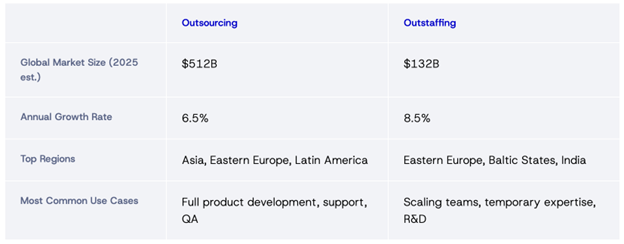
Source: Statista 2025, Grand View Research 2024, Deloitte Global Outsourcing Survey 2024
3. Pros and Cons
Outsourcing: Pros
✅ Full project responsibility on vendor
✅ Cost predictability and reduced internal workload
✅ Access to diverse tech expertise
✅ Faster start for projects without internal capacity
Cons
❌ Less control over daily execution
❌ Risk of communication gaps
❌ Harder integration with in-house systems
❌ Dependency on vendor’s management quality
Outstaffing: Pros
✅ Full control over assigned developers
✅ Easy integration with internal processes
✅ Scalable and cost-efficient staffing
✅ High transparency and collaboration
Cons
❌ Requires strong internal management
❌ You remain responsible for delivery outcomes
❌ Possible challenges with time zones or communication
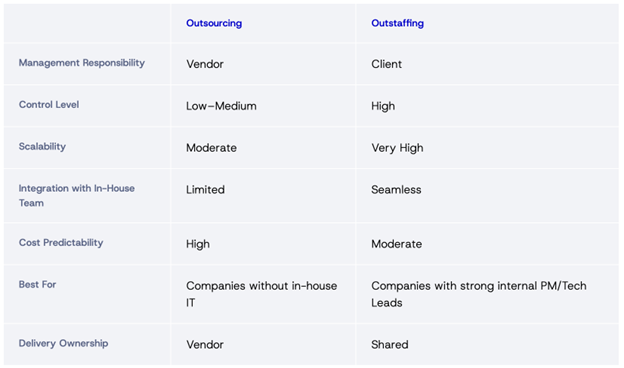
Comparison Table: Outsourcing vs Outstaffing
4. When to Choose Each Model
✅ Choose Outsourcing If:
- You need end-to-end delivery (e.g., MVP, mobile app, full platform).
- You don’t have in-house tech management or development resources.
- Time-to-market is critical and you prefer a turnkey solution.
- You want to reduce management overhead.
✅ Choose Outstaffing If:
- You already have a technical core team but lack specific skills.
- You want long-term collaboration with developers under your leadership.
- You need scalable resources for ongoing projects.
- You prioritize transparency and control over execution.
5. Cost Implications
While both models are cost-efficient, the structure of expenses differs:Example:
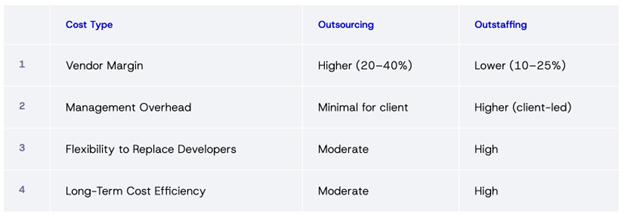 A mid-sized US company developing a SaaS product could save 25–30% with outstaffing compared to traditional outsourcing (Clutch 2024).
6. Regional Perspective: Why Eastern Europe Leads
Countries like Ukraine, Poland, Romania, and the Baltics dominate both outsourcing and outstaffing services.
Ukraine alone employs over 200,000 IT professionals (IT Ukraine Association, 2024) and continues to attract clients with high technical skill, English proficiency, and European work culture.
Benefits of choosing Eastern Europe:
- Strong STEM education
- Competitive rates ($35–55/hour average)
- Minimal cultural and time zone gap
- Proven reliability during crises
7. Future Outlook
By 2030, hybrid engagement models — combining outsourcing for delivery and outstaffing for scaling — will dominate IT partnerships (Deloitte 2025 forecast).
Companies will increasingly prioritize control, flexibility, and transparency over lowest cost.
8. Final Recommendations
- Business Type: Startup building MVP
Recommended Model: Outsourcing
- Business Type: Mid-size company scaling product
Recommended Model: Outsourcing
- Business Type: Enterprise seeking cost optimization
Recommended Model: Hybrid model
- Business Type: Business without IT department
Recommended Model: Outsourcing
- Business Type: Tech-led organization with PM team
Recommended Model: Outstaffing
In short:
- Choose outsourcing when you need a complete, managed solution.
- Choose outstaffing when you want to expand your existing team efficiently.
Both can be powerful — if aligned with your company’s structure, goals, and technical maturity.
Sources
- Deloitte Global Outsourcing Survey 2024
- Statista IT Outsourcing Market Forecast 2025
- Grand View Research, “Staff Augmentation Market Size Report 2024”
- Clutch, Global IT Cost Benchmark 2024
- IT Ukraine Association 2024